
Commercial Garage Door Maintenance Checklist
By the H&D Garage Door team · Updated
What should a commercial garage door maintenance checklist include?
A commercial garage door maintenance checklist should cover three levels of care: quick daily checks staff can do without tools, a short monthly walk-through by a manager, and professional service on a schedule set by how many cycles the door runs. Each level looks at the same core items: the door's movement, its safety devices, the springs and cables, the operator, and the seals and frame.
The goal is to catch problems while they are small. Commercial doors on warehouses, loading docks, fleet garages and service bays can run dozens or hundreds of times a day. A worn roller or frayed cable that a homeowner might not notice for months can stop a dock in weeks.
Why do commercial doors need more maintenance than residential doors?
Cycle count is the big difference. Springs, cables, rollers and operator gears all wear in proportion to use. A door that opens and closes all shift long uses up its parts far faster than a home door, which is why many commercial doors are fitted with high-cycle springs.
Commercial doors are also bigger and heavier, they get hit by forklifts and trucks, and they often protect inventory, equipment or temperature-controlled space. A door stuck open is a security and energy problem. A door stuck closed can stop shipping and receiving entirely.
What should staff check every day?
These are look-and-listen checks for whoever opens the building or runs the dock. No tools, and no touching the springs, cables or operator internals.
- The door opens and closes fully without stopping, jerking or reversing
- No new grinding, banging, popping or scraping sounds
- Photo eyes and edge sensors are clear of pallets, debris and ice
- The bottom of the door and the tracks are free of obstructions
- No visible damage from vehicle or forklift impacts
- Remotes, push-button stations and keypads respond normally
What should a manager check each month?
A monthly walk-through takes a few minutes per door and gives early warning of wear. Record what you find so trends are easy to spot.
- Test the safety reversal by placing an object in the door's path as the operator manual describes
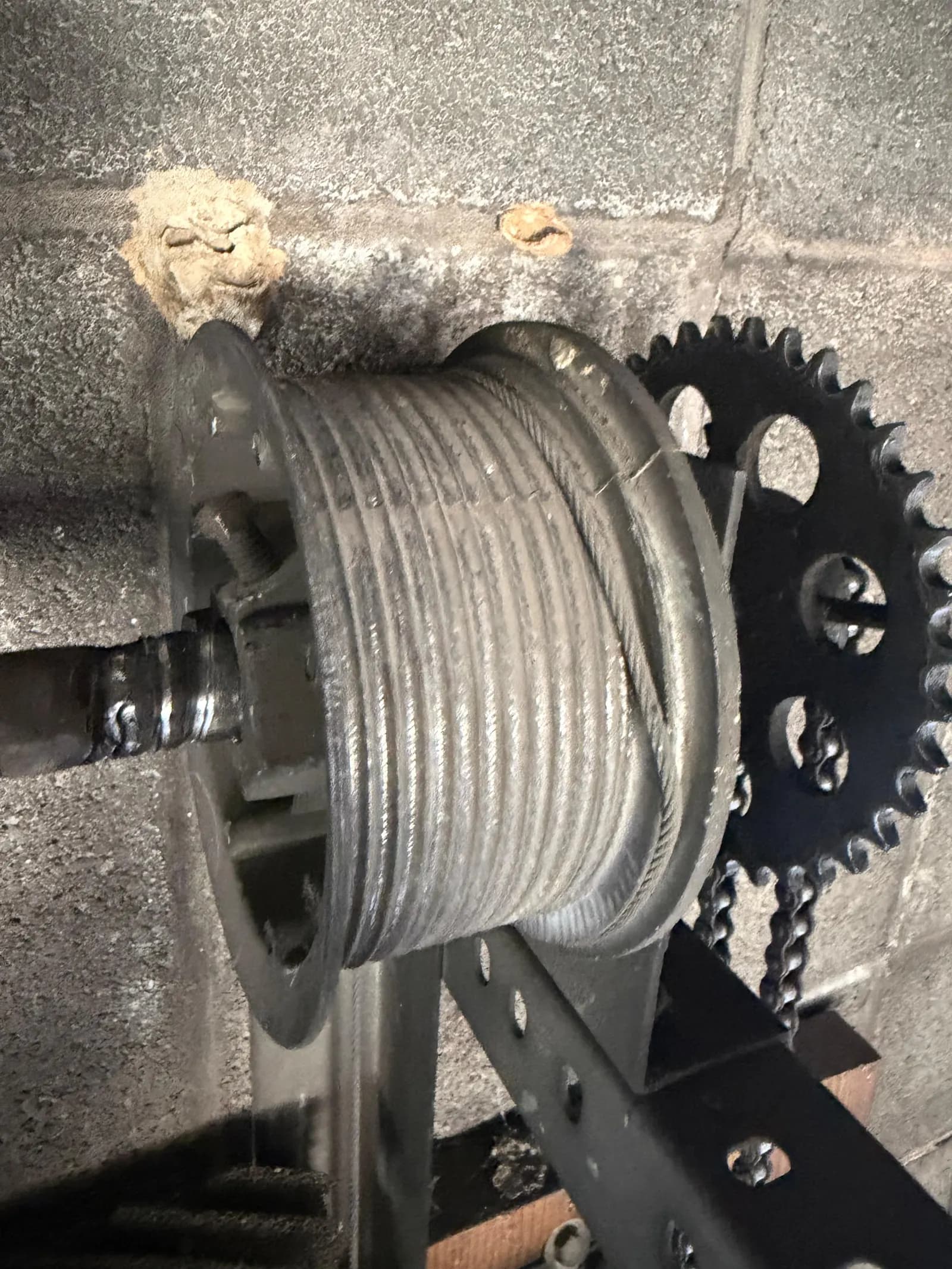
- Look for frayed, rusted or slack cables from the floor
- Look at springs from a distance for gaps, rust or stretching
- Check rollers, hinges and guides for wear, wobble or missing parts
- Inspect tracks and guides for bends, loose anchors or impact damage
- Check bottom seals, weatherstripping and dock seals for tears and gaps
- Make sure warning labels and manual-operation instructions are still legible
- Confirm the manual chain hoist or release works where one is fitted
What does professional maintenance cover?
A technician handles everything under tension and inside the operator. That includes checking and adjusting spring tension and door balance, inspecting cables, drums and bottom brackets, lubricating bearings, hinges, chains and the barrel or shaft on rolling doors, checking the operator's gears, brake, clutch and limit settings, and testing photo eyes, edge sensors and reversal force.
Rolling steel doors have their own needs: the barrel assembly, curtain slats, endlocks and guides wear differently from a sectional door. High-speed fabric doors and insulated sectional doors each have parts specific to their design. A technician who works on commercial garage door repair will know what to look for on each type.
How often should commercial doors be serviced?
Base it on cycles and conditions rather than a fixed calendar. A door that runs constantly at a busy dock may need professional service every quarter. A door that opens a few times a day at a small shop may be fine with service twice a year. Doors exposed to salt, moisture, temperature swings or frequent impacts need more attention.
If you don't know how many cycles your doors run, many operators keep a count, or you can estimate from shift patterns. Spring life is rated in cycles, so the count also helps you plan spring replacement before a break. Our guide on how long garage door springs last explains cycle ratings.
What should you check around loading docks?
Dock doors take more abuse than any other door on a property. Add a few dock-specific items to the monthly walk-through. Look at the dock bumpers for chunks missing or loose anchors, since worn bumpers let trailers strike the wall and the door frame. Check the dock seals or shelters for tears that let weather and pests in around the trailer.
Look closely at the bottom section and the lower part of the tracks or guides, where forklifts and pallet jacks most often hit. Even a small bend near the floor can make the door bind higher up. Make sure painted floor markings and any bollards or track guards protecting the door are intact, because those are what keep the next impact from reaching the door at all.
How should you keep maintenance records?
A simple log for each door makes every other part of this checklist work better. Give each door a number and record the date of every check, every problem found, every repair and every professional visit. Note the cycle count if the operator shows one.
Over a few months, the log shows patterns. A door that needs the same repair again and again may have an underlying cause, such as a misaligned track or the wrong spring size. A door whose cycle count is climbing toward its spring rating can be scheduled for spring replacement before a break stops work. Records also help when an insurer, landlord or inspector asks how the doors are maintained.
What about fire doors?
Rolling fire doors are a separate category. Under NFPA 80, the national standard for fire doors, fire door assemblies must be inspected and tested at least once a year, with a drop test that confirms the door closes on its own, and the results recorded. Your local fire marshal or insurer may ask to see them. Treat fire door inspections as their own line on your checklist and use a technician familiar with fire door testing.
Which warning signs mean you should call right away?
Some problems shouldn't wait for the next scheduled visit. Take the door out of service and call if you see a broken spring, a frayed or snapped cable, a door that is crooked or off its guides, a curtain that has jammed in a rolling door, or impact damage to the tracks or bottom section. Do the same if the safety reversal fails its test. A door that won't reverse on an obstruction is a serious hazard in a busy workplace.
Operators that run, stop and restart on their own, or that run but don't move the door, also need a technician, since the fault may be in the operator, the door or both.
Should gates and access control be on the same checklist?
If your site has a gated lot or yard, it makes sense to inspect gates on the same schedule. Gate operators share many of the same failure points: safety sensors, limit settings, worn hinges or rollers, and access control devices that stop reading cards or codes. See commercial gate repair for what that service covers.
For businesses in Middle Tennessee, our Nashville service area page covers the areas we serve. Call (888) 754-4130 to set up maintenance for your doors.