Signs you need gate openers
- The operator hums or clicks but the gate does not move
- The motor runs but the gate does not move, or moves in jerks
- Grinding, popping or clicking from the gearbox or drive
- The gate overshoots or stops short of its open or closed position
- Error codes, beeping or flashing lights on the control board
- The control board has burn marks, a swollen part or a corroded terminal
- A swing gate arm is bent, cracked or has come loose from its bracket
- A slide gate chain is slack, jumping or the gear rack is chewed
- The operator gets hot and quits after a few cycles
Gate opener vs. gate operator: is there a difference?
In practice, no. "Gate opener" is the homeowner term and "gate operator" is the trade term for the same thing: the machine that moves a gate on command. Both terms cover swing gate operators, slide gate operators, barrier arm operators and the control board inside each one.
The difference that matters is the type of gate and how hard the operator is worked. Light-duty openers built for a single-family driveway are not designed for a gate that cycles hundreds of times a day. Heavy commercial operators are larger, run on higher-duty motors and have more inputs for loops, access control and fire department access. When an operator keeps failing, the first question is whether it is the right class for the gate and the traffic.
This page focuses on the operator. If the gate itself is sagging, dragging or damaged, start with gate repair.
How do swing gate operators fail?
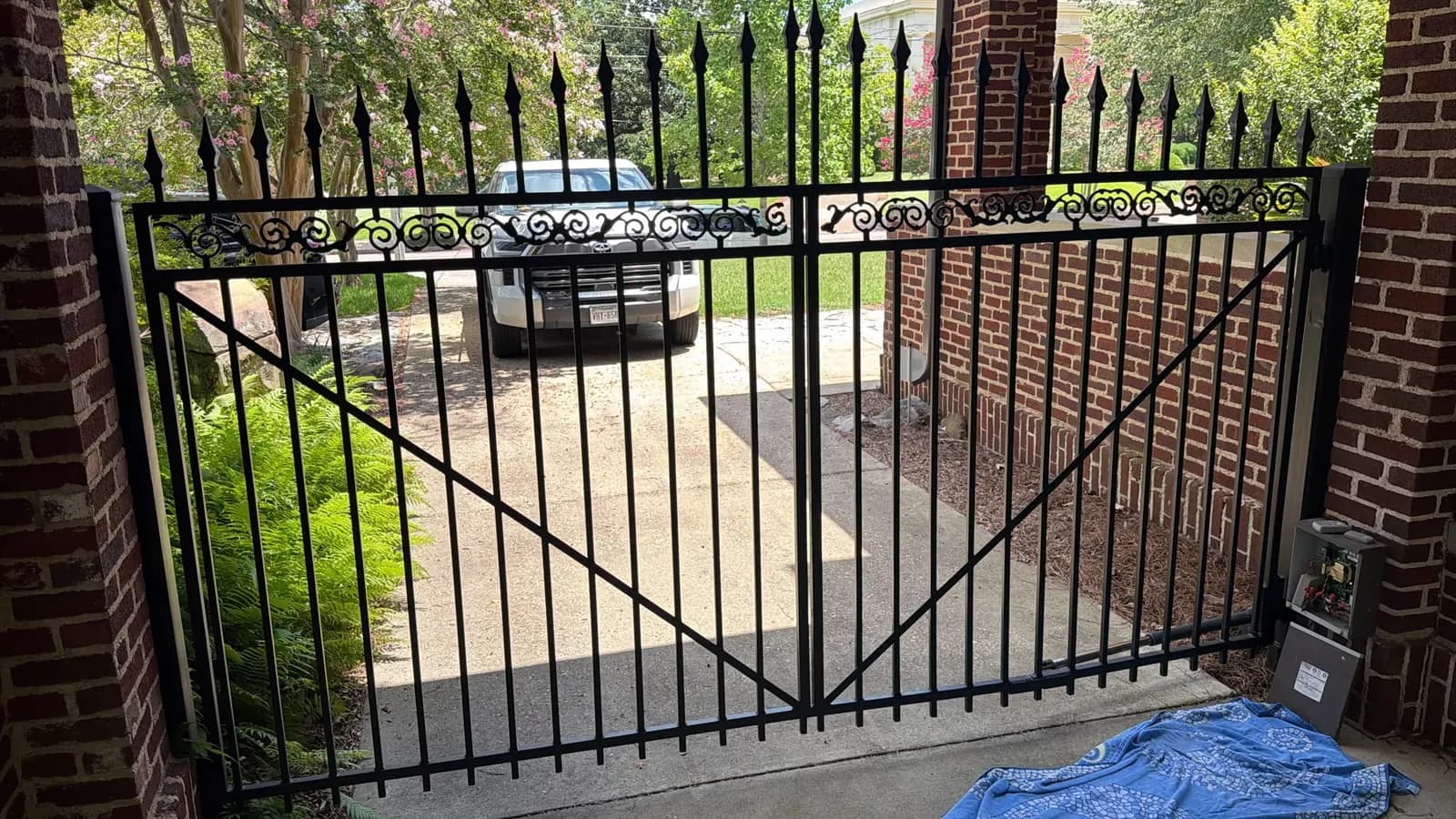
Swing gate operators come in a few designs: linear arm (piston-style) operators that push and pull the gate, articulated arm operators that fold like an elbow, pad-mounted operators beside the post, and underground operators hidden beneath the hinge.
Common failures we see:
- Stripped gears or worn screw drives in linear arm operators, often from a gate that sags or catches wind like a sail.
- Bent, cracked or loose arms and brackets after a gate is forced, hit or blown hard by wind.
- Failed motors or capacitors, which show up as humming without movement.
- Water in underground operators, which sit in a box below grade and depend on good drainage.
- Out-of-sync dual gates, where one leaf closes before the other or they collide in the middle.
- Limit drift, where the gate stops short or slams into its stop.
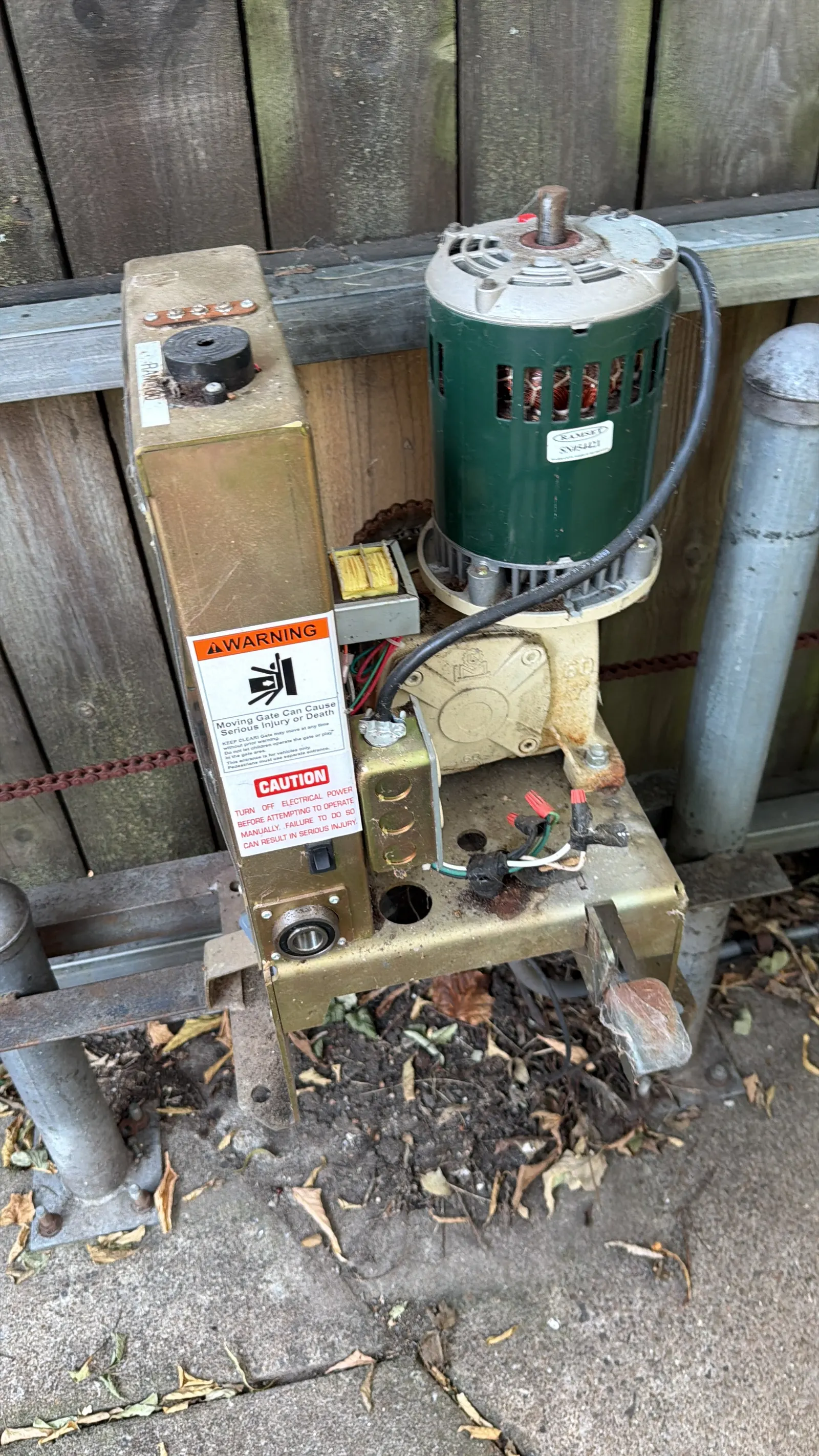
How do slide gate operators fail?
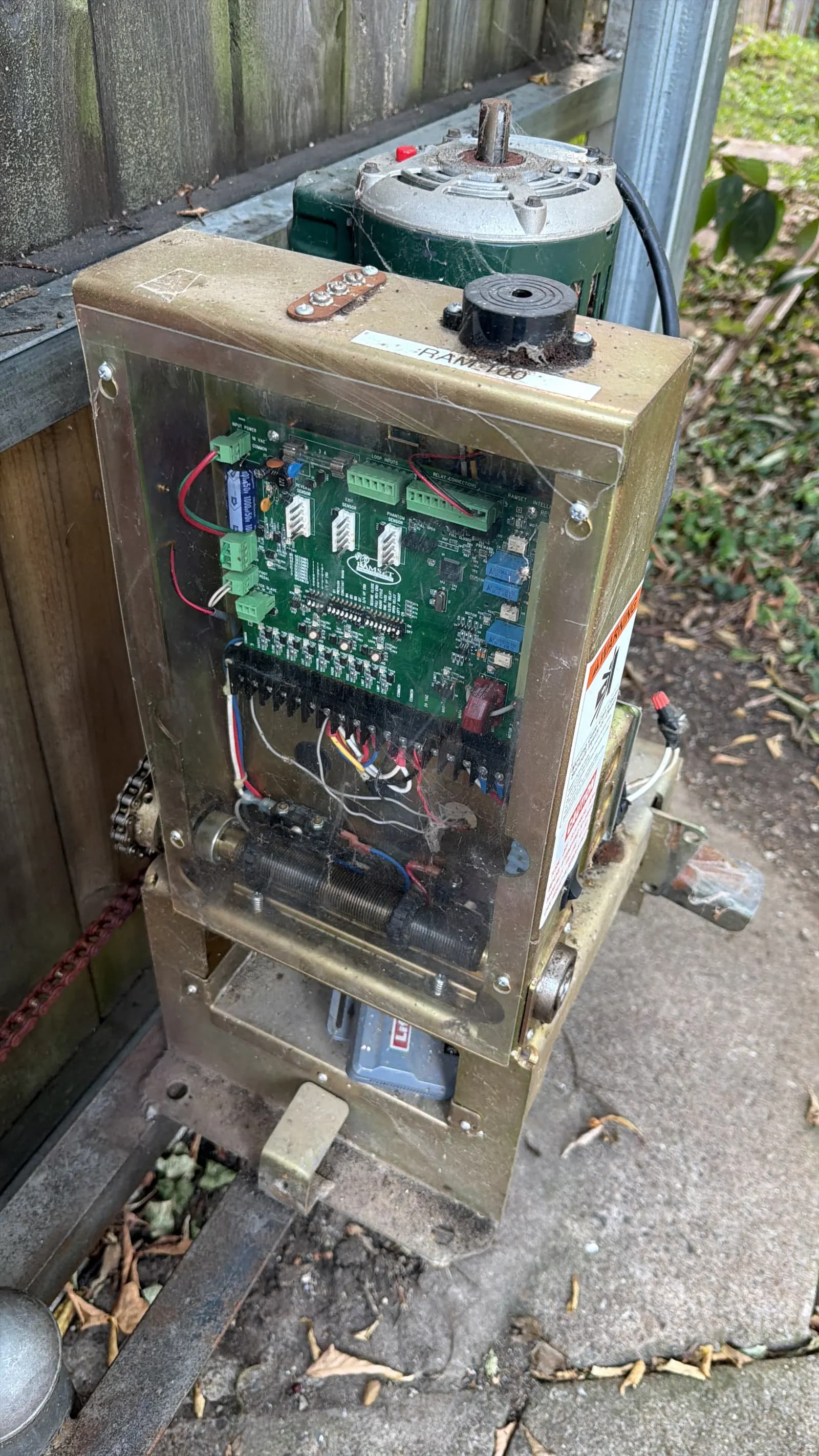
A slide gate operator sits beside the gate and drives it through a chain or a gear rack bolted along the gate. The motor turns a gearbox, the gearbox turns a drive sprocket or pinion, and the gate rolls.
Chain-drive operators need the chain at the right tension and aligned with the sprocket. A slack chain slaps and jumps; an over-tight chain wears bearings and strains the motor. Rack-and-pinion operators need the rack at a steady height along the full length of the gate, or the pinion will skip and chew teeth.
Inside the operator, we see worn drive gears, failed bearings, slipping clutches, worn belts on some designs, failed motors and limit switches that no longer stop the gate in the right place. A slide gate operator is only as healthy as the gate it drives: worn wheels, a bent track or a broken guide roller multiply the load. We check both. If your gate is reversing or stopping halfway, our automatic gate repair page explains the common causes.
Can a gate opener control board be repaired?
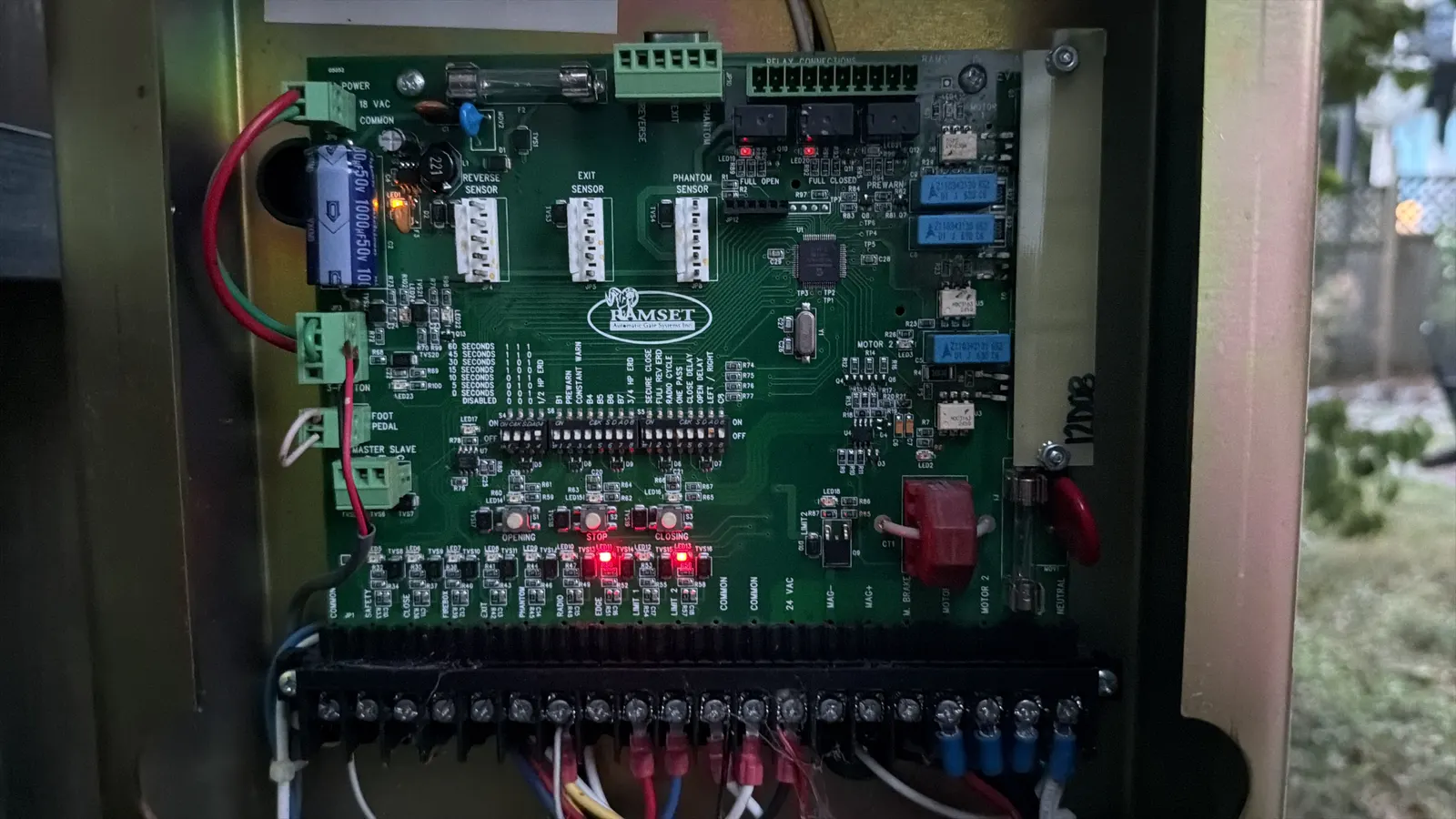
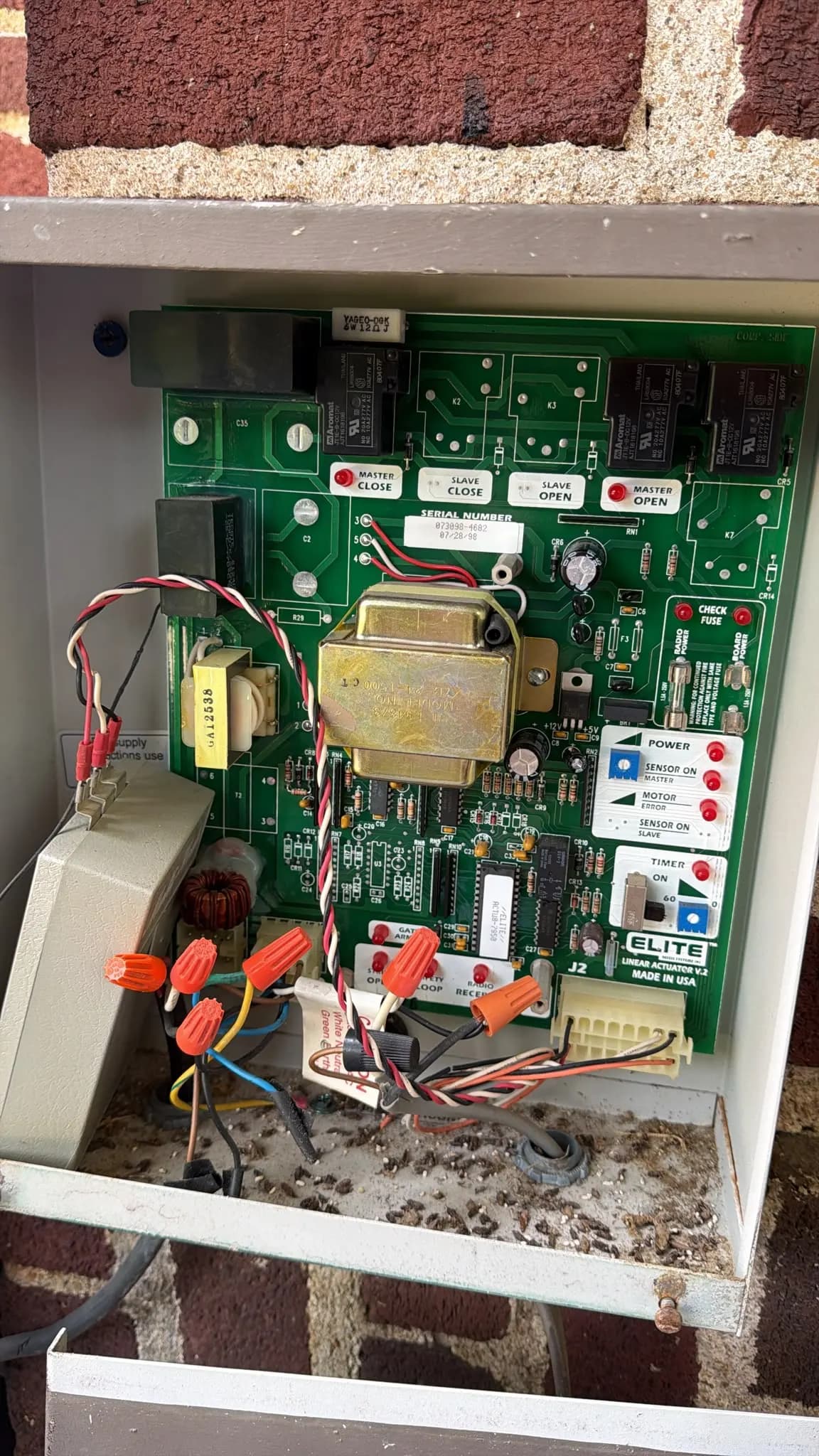
The control board is the operator's brain. It reads the remote receiver, keypads, loops, photo eyes and limits, decides when to run the motor, and sets force, timers and safety behavior. Many boards also carry DIP switches or menu settings that control auto-close timing, single or dual gate mode and how the gate reacts to each input.
Boards fail from power surges, lightning, water, insects nesting in the housing, corroded terminals and simple age. Sometimes the board itself is fine and a single input, plug or fuse is the problem. We test the inputs and outputs before calling a board bad, because replacing a board will not fix a shorted sensor wire.
When a board does need replacing, we install a compatible board, transfer settings, relearn limits and force, and re-test every safety device. On older operators, a matching board may no longer be made; in that case we explain whether a replacement operator makes more sense.
Which gate opener brands do you work on?
We service most major brands of gate operators. The names we see most often on swing, slide and barrier gates include LiftMaster, Viking, DoorKing, FAAC, Elite, Ramset and Mighty Mule, along with other residential and commercial brands.
Each brand has its own parts, error codes and setup menus, and many have both residential and commercial lines. The fastest way to get the right repair is to send us a photo of the label on the operator, showing the brand, model and serial number, and a photo of the control board if you can see it safely without opening anything.
If parts are no longer available for an older operator, or the operator is undersized for the gate, we can quote a replacement operator as part of gate installation. Keypads, intercoms and card readers wired into the operator are covered on our gate access control page.
What affects the cost of gate opener repair?
We do not publish flat prices, because the same symptom can have very different causes. A gate that hums and does not move might need a small electrical part or a full gearbox. We diagnose first and quote the repair before any work starts. What affects the cost of a gate operator repair:
- Which part failed: a sensor or fuse is a different job from a gearbox or motor.
- Operator brand and class: commercial operators use heavier, more specialized parts.
- Swing vs. slide vs. underground: underground operators take more labor to reach.
- Single or dual gate: two leaves mean two operators to sync and test.
- Whether the gate hardware also needs work so the new part does not fail again.
- Parts availability for older or discontinued models.
Repair the operator or replace it?
Repair is usually the right call when the operator is the right size and class for the gate, parts are available, and the failure is a single component. Replacement is worth discussing when the operator has had repeated major failures, parts are discontinued, the operator lacks modern monitored entrapment protection, or it was never rated for the gate's weight, length or traffic.
Because safety standards for gate operators have changed over the years, an older operator can be working but still lack features current operators include, such as monitored photo eyes and edges. A gate's weight can also change over time: privacy panels, new infill or a heavier latch add load the original operator was never sized for. We will tell you what we see, show you the failed part, and let you decide. We also handle garage door opener repair if your garage door opener is acting up too.
How the service works
- 1
Identify the operator
Brand, model, swing or slide, and photos of the label help us bring the right parts and manuals.
- 2
Diagnose inputs and power
We read error codes and test the board's inputs, fuses and power before condemning any part.
- 3
Check the drive and gate
Gears, chain or rack, arms, motor and the gate's hardware are checked together.
- 4
Repair, set and test
We replace the failed part, relearn limits and force, and confirm every safety device reverses the gate.