
Automatic Gate Repair Cost: What Affects the Price?
By the H&D Garage Door team · Updated

How much does automatic gate repair cost?
Automatic gate repair cost depends on six things: what failed, whether parts are still made for your operator, the operator's type and age, the gate's size and weight, any site work such as wiring or pavement, and the access hardware involved. A loose photo-eye wire and a burned-out gearbox can look the same from the driveway, because the gate just sits there, but they are very different repairs.
That's why we don't post a number, and why the ranges you see online rarely match the bill. They can't know which part failed on your gate. What we can do is help you understand what each kind of repair involves, so the quote makes sense when you get it. If your gate stopped working and you haven't done the basic safe checks yet, start with our guide to why a gate opener stops working.
What are the six things that drive an electric gate repair bill?
Every gate repair quote comes back to some mix of these.
- Failure type. Electronics, motor and gearbox, safety devices, vehicle loops, mechanical hardware and access control are different jobs with different parts.
- Parts availability. A current part from stock is one thing. A discontinued board for an older operator may mean searching for a compatible part, or replacing the operator.
- Operator type and age. Swing arms, pad-mounted slide operators, underground operators and barrier arms each have their own parts. Solar and AC-powered operators fail in different ways.
- Gate size and weight. A long or heavy gate needs a larger operator, heavier hinges or rollers, and sometimes two technicians.
- Site work. New wiring, conduit, a replacement loop cut into pavement, or a damaged post or pad all add labor beyond the part itself.
- Access hardware. Keypads, intercoms, card readers and remotes add their own parts, wiring and programming time.
What do common gate repairs involve, and what moves the price of each?
Here is what a technician typically does for each kind of failure, and which details make that repair larger or smaller.
- Operator motor or gearbox. The tech tests the motor, checks the gearbox, arm or drive chain and replaces the failed part. Price moves with the operator model, whether the part is still made, and whether a worn gate caused the failure.
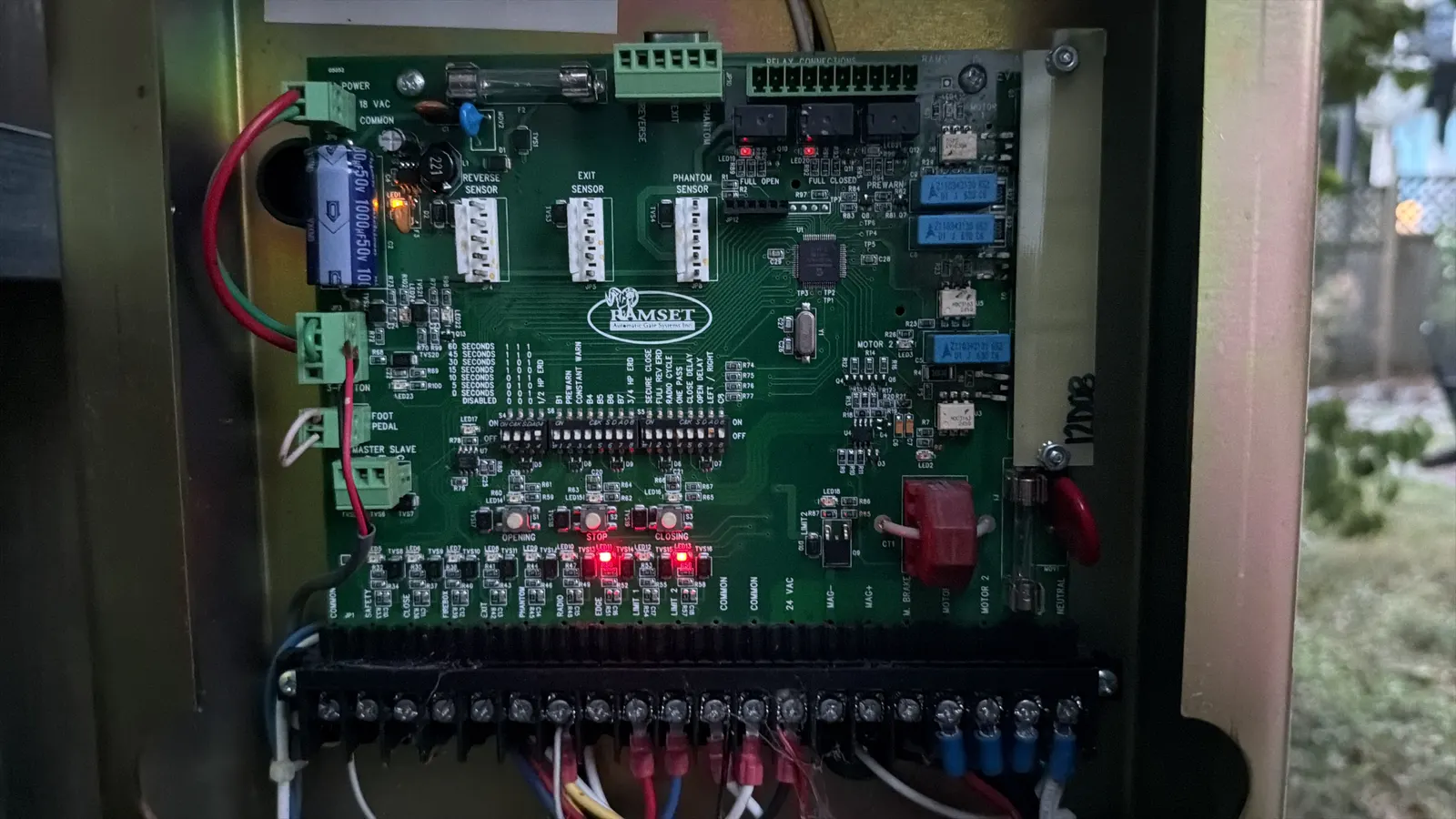
- Control board. Often damaged by a power surge, lightning or water getting into the control box. The tech confirms the board is the fault, replaces it, then sets limits, force and timers. Price moves with board availability and whether the surge took out other parts too.
- Photo eyes and safety edges. The tech realigns, rewires or replaces the sensors and tests that the gate stops and reverses. Price moves with the number of sensors the gate needs and whether the operator can monitor them under current rules.
- Vehicle loops and loop detectors. Loops are wires cut into the pavement that sense cars for exit and safety. A failed detector module is a smaller fix. A broken loop wire means re-cutting and sealing pavement, which is site work.
- Hinges, rollers, track and posts. A sagging swing gate, a worn roller on a sliding gate, or a bent track makes the operator fight the gate. Our gate repair page covers this mechanical work. Price moves with gate weight, welding needs and post condition.
- Keypads, intercoms and remotes. The tech tests the device and its wiring, replaces what failed, and reprograms codes or remotes. Price moves with the system type and how many users need codes.
- Power and batteries. Solar operators rely on a panel and batteries that wear with time, and a shaded panel can't charge them. AC operators depend on the power run to the gate. Price moves with the battery or charging parts needed or the wiring repair.
- Vehicle or storm damage. A gate hit by a car or a fallen limb often needs mechanical, electrical and safety repairs at once. The tech assesses each system before quoting.
Should you repair the gate operator or replace it?
Repair usually makes sense when parts are available, the operator is rated for your gate's weight and length, and its safety devices meet current rules. Most single-part failures on a healthy operator fall into this group.
Replacement starts to make sense in a few situations. The board or motor is discontinued. The operator is undersized for the gate, which manufacturers spell out as a maximum gate weight and length. It has needed several repairs in a short time. Or it predates the safety changes that took effect in January 2016. Under the current UL 325 standard, the external safety sensors on a gate operator have to be monitored, meaning the operator checks that they are connected and working, and switches to hold-to-run operation if they aren't. Some older operators can't do that, so bringing an old gate up to current safety practice can mean a new operator rather than new sensors alone.
Switching power type is another reason. If a solar operator keeps going dead because the panel sits in winter shade, or an AC operator lives where storms keep knocking out power, it may be worth comparing a different setup.
Why are HOA and commercial gate repairs planned differently?
Community and commercial gates are a different class of job. UL 325 sorts gate operators into usage classes, from residential (Class I) to commercial and public access (Class II), industrial (Class III) and restricted-access sites (Class IV). A busy HOA entrance or a business park gate can cycle many times an hour, so its operator, loops and access hardware wear faster, and replacements need to be rated for that duty.
Safety scope is larger too. Gates that the public uses are expected to meet both UL 325 for the operator and ASTM F2200 for the gate itself, which covers things like guarding rollers and keeping openings near the ground small on sliding gates. A repair on an older community gate can turn up compliance work that a homeowner's gate never would.
Downtime is the other big factor. A gate stuck open is a security problem, and a gate stuck closed blocks residents, deliveries and emergency access. Part of planning the repair is how to keep the entrance working in the meantime, and who at the HOA or property management company approves the work. In Central Florida, where many neighborhoods have gated entrances, and around Nashville, where automatic gates are common on homes and communities alike, these are the jobs where a clear scope matters most. See commercial gate repair and our Nashville automatic gate repair page.
How do you get an accurate gate repair quote?
The more we know before the visit, the closer the first conversation gets to the real scope. Gather these from a safe distance, and keep clear of the gate's path while you do.
- Gate type: single swing, double swing, sliding or barrier arm, and roughly how long and tall it is
- The operator's brand and model from the label on the motor or control box
- Whether it runs on solar or on AC power
- What it does now: won't open, won't close, stops partway, reverses, beeps, or runs but the gate doesn't move
- Any error codes or beep patterns on the board (our gate opener error code guide shows how codes are read on one widely used line of operators)
- Photos of the whole gate, the operator, the hinges or track, and the keypad or intercom
- For HOA or commercial gates, who approves the work and how the technician gets access
Ready to have your gate looked at?
Our automatic gate repair page explains how a gate service visit works. We repair automatic gates in Orlando, Nashville, Cleveland and Milwaukee. Call (888) 754-4130 and we'll schedule the earliest available visit, find what failed and give you the price before any work starts.